
An open directory was found on a server in Latvia, on port 23883. Behind it sat 10,138
files: Russian operator notes, credential harvesting scripts, exfiltrated filesystems, and
the crew's own SSH persistence keys. The directory root was the operator's /root folder,
served straight from a Python http.server. None of it had been cleaned up.
The files read like a field diary of an operation whose entire purpose was stealing access to AI models. The crew, which calls itself SKH in its own notes, was harvesting Claude and OpenAI OAuth tokens from an AI API relay business and routing them back through its own relay chain. The exposed directory did more than describe the attack. It named three servers the operation ran on that weren't in any public reporting.
At a glance
- The server at
31.58.77[.]28exposed an open directory on 23883/tcp in AS56971, CGI GLOBAL LIMITED, Latvia. The listing carried aDirectory listing fortitle, the signature of Python'shttp.server. - The operators work in Russian under a hierarchy, a general directing numbered operators,
with tasks filed as
T001throughT160. They refer to the staging host in their own notes as the terminator. - The operation's object was AI model access. The directory held a pool of 2,310 OpenAI OAuth account files and a documented plan to collect Claude OAuth token pairs.
- The attack method centered on redirecting a target's AI egress traffic to a listener on
31.58.77[.]28:8799, then passing the harvested tokens up a relay chain. - The most significant finding is three pieces of attacker infrastructure, none previously
published:
62.84.98[.]53, an OAuth gateway and token mirror, the proxy domainseize-the-means-comrade.duckdns[.]org, and the attacker-controlled host8.140.239[.]129. - Persistence on compromised hosts rode a single named SSH key,
skh_persist, plus cron entriesskh-monitorandsys-maintenance. - None of the indicators pulled from these files appear in prior public reporting, so the relay infrastructure looks previously undocumented.
Background
This operation was not found in public reporting online. No external advisory, actor profile, or indicator overlap surfaced for any of the hosts or artifacts, and no CVE is tied to the activity. The campaign is reconstructed here from the operator's own files recovered from the exposed directory, kept separate from any outside account because there isn't one. The actor name SKH is the crew's own label from its notes, not an external designation.
Discovery
Etugen reached the operation through the open directory on 31.58.77[.]28. The host sits in
AS56971, CGI GLOBAL LIMITED, registered in Latvia, with a single exposed port, 23883/tcp,
serving a Python http.server listing rooted at the operator's /root directory. Etugen's
threat catalog carries no prior record for this IP, only the Trashpile record, first seen on
2026-11-12. Trashpile classified the contents across scanner, password-cracking,
exfil, history, exposed-backup, exposed-database, exposed-secrets, git-exposure, and exploit
categories.
The hosting itself is a weak signal rather than a link. Etugen tracks 39 malicious hosts in AS56971, spanning Mirai, Supershell, XWorm, CobaltStrike, and Havoc, which points to a loosely policed provider. On its own that places the staging host among bad company without tying it to any of those families.
| Address | Role | Open port | Service | Verification |
|---|---|---|---|---|
31.58.77[.]28 |
SKH staging and token terminator | 23883/tcp | Python http.server open directory |
Etugen Trashpile |
62.84.98[.]53 |
OAuth gateway transit hop and token mirror | - | HTTP relay | Inferred from file contents |
8.140.239[.]129 |
Attacker-controlled host | - | Referenced in sweep output | Inferred from file contents |
seize-the-means-comrade.duckdns[.]org |
SKH OAuth gateway HTTP proxy | 8797/tcp | HTTP proxy | Inferred from file contents |
No independent port scan was run against any of these hosts. Only 23883/tcp on
31.58.77[.]28 was observed directly by Trashpile. The other ports in this post, 8799, 8803,
12555, and 9922, were read from the operator's scripts and notes, not confirmed open by a scan.
Inside the staging directory
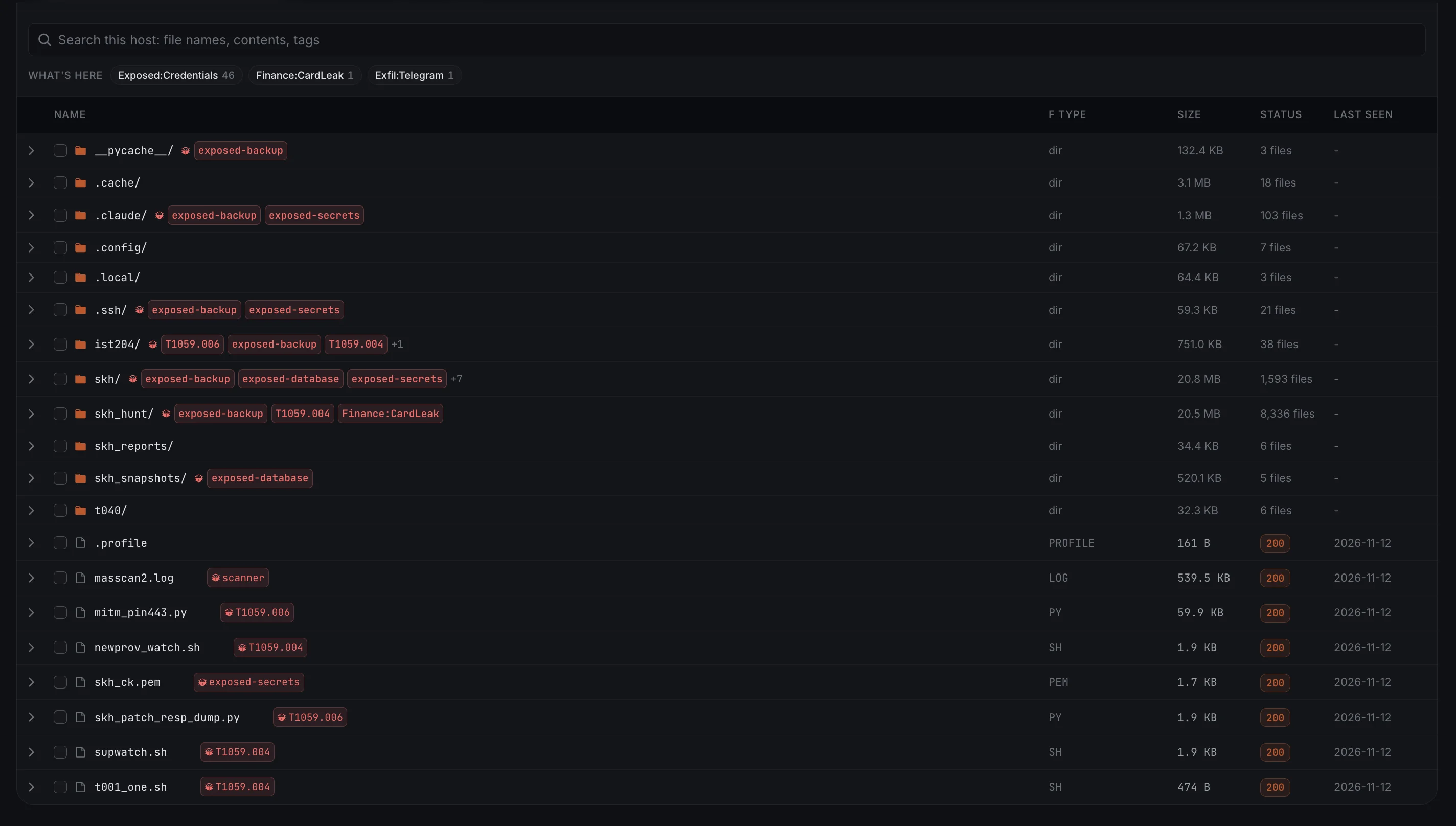
The directory is laid out as a working operation. Stable path conventions run through nearly
every script and note: /root/skh/ for staging and exfil, /root/skh_hunt/ for the token
pipeline, and temporary working areas under /tmp/skh_pin/, /tmp/.skh_exfil/, and
/tmp/skh_mitm_standby/. Those paths are the firmest fingerprint the operation leaves, because
they recur across unrelated files written at different times.
Operator reports are filed as dated Russian-language Markdown. A nightly exfil report records counts of harvested tokens, root access tokens, and a stealth administrator account planted on a target. A runbook lays out the token chain as terminator to OAuth gateway to a pulling node behind NAT, then to the operation's owner. The tone throughout is that of a crew keeping its own books, not of a single smash-and-grab.
Two things are striking for their sheer volume. A pool directory held 2,310 OpenAI Codex OAuth account files, each a stored credential set. A separate plan described collecting Claude OAuth token pairs by redirecting a target's AI egress through the terminator listener. The leaked tokens in these pools most likely belong to the target rather than the operator, which shapes the remediation below. The target was itself a gray-market model reseller, so this reads as one illicit operation looting another, but the downstream customer tokens caught in the pools are the real exposure.
The relay chain
The operation's own notes describe a short chain for moving stolen OAuth tokens off the target
and up to the operator. The terminator on 31.58.77[.]28 is the near end. From there, scripts
named oat_strip.sh and oat_queue_gen.sh set the OAuth gateway variable to 62.84.98[.]53
and reference a key named id_az_oatgw, placing 62.84.98[.]53 as the OAuth gateway transit
hop and token mirror. A sweep result recovered from a compromised host recorded a proxy entry
pointing at seize-the-means-comrade.duckdns[.]org on 8797/tcp, the HTTP front for that
gateway.
8.140.239[.]129 is tied to the operation two independent ways. The operator's own
authorized_keys on the staging host carries a key commented root@iZ2ze96cvwq4ia26vbny12Z,
an Alibaba Cloud instance name, and the same instance name appears as the host of a sweep
output file under /root/loot_repos. That makes the host attacker-controlled with high
confidence, whether owned outright or repurposed after compromise.
The relay endpoints behave like the operator's own kit. A monitoring script, skh_monitor.sh,
checks availability and maintains the skh_persist key and a reverse tunnel on 9922/tcp. Other
launchers reference a gRPC certificate theft tool on 12555/tcp and a MITM proxy on 8803/tcp.
These are the ports to watch for alongside the terminator on 8799/tcp.
The operator's own exposure
For all the care it spent breaking into other networks, the crew took almost none with its own
server. The entire operation, source
scripts, runbooks, exfiltrated victim data, OAuth pools, and the operator's own SSH keys, sat
in one world-readable directory served by http.server. Loot extracted from the files included
reused database passwords, a PostgreSQL connection string, a masked Telegram bot token, and
masked API keys, all belonging to the operation rather than hidden from it.
The authorized_keys file alone maps the operator's access topology. Key comments name a desk
workstation reaching a hosting provider, sensor and backup roles on an OAuth gateway station,
and an operator handle, dumbaq, that also appears in a nightly report as one of the crew's own
accounts. The same authorized_keys that let the crew pivot between its own machines now hands
a defender the full map of that access.
Hunting for more
The operation's naming conventions turned into tight Etugen searches. The staging paths, the persistence key name, and the tool names are specific enough that each returns only this operator's files, which is what makes them good detection content as well as good pivots.
| Pattern | Evidence | Etugen query | Matches | New | Confidence |
|---|---|---|---|---|---|
| OAuth gateway host in strip scripts | oat_strip.sh, oat_queue_gen.sh |
content:"oatgw" scoped to seed host |
3 | 2 | high |
| Shared relay domain | sweep output proxy entry | seize-the-means-comrade.duckdns.org |
1 | 1 | high |
| Token pipeline path | pipeline scripts | content:"/root/skh_hunt/" |
10 | 0 | high |
| Persistence key name | skh_monitor.sh |
content:"skh_persist" |
1 | 0 | high |
| gRPC cert theft launcher | launcher script | content:"grpc_cert_thief" |
1 | 0 | high |
| Credential harvester output | sweep JSON | content:"files_with_creds" |
2 | 1 | medium |
The content:"oatgw" search is what surfaced both 62.84.98[.]53 and
seize-the-means-comrade.duckdns[.]org. A loot search for a reused database password
recovered from the host returned two hosts, confirming credential reuse across the target fleet. Every
operation-specific string resolved only to 31.58.77[.]28, so the crew's artifacts have not
turned up on any second server yet. The neighbouring 31.58.77[.]0/24 and 62.84.98[.]0/24
ranges held no additional tracked hosts, and no other host exposed port 23883.
Four YARA rules from this hunt run in Etugen's YARA scanner over files collected from attacker open directories, so a future exposure of the same kit is caught on sight. The toolkit rule keys on the staging paths and the hardcoded relay addresses:
rule SKH_Operator_Toolkit_Scripts {
    strings:
        $i1 = "OATGW=62.84.98.53"
        $i2 = "seize-the-means-comrade.duckdns.org"
        $i3 = "31.58.77.28:8799"
        $p1 = "/root/skh_hunt/"
        $k1 = "skh_persist"
        $t1 = "grpc_cert_thief"
    condition:
        filesize < 2MB and (any of ($i*) or 2 of ($p1,$k1,$t1))
}
Tactics and techniques
The chain was assembled from the operator's scripts, notes, and logs rather than from a port
scan, so the techniques below are inferred from file contents. The emphasis sits in Credential
Access, where application-token theft, bash-history and private-key scraping, and SSH and web
panel password guessing all appear in named tools. Persistence through an SSH authorized key, a
cron job, and a planted stealth account is documented in the operator's own reports. The BMC
firmware technique is present only as a script and is marked confirmed: false.
Credential Access
- T1528Steal Application Access Token Claude sk-ant-oat01 and OpenAI Codex OAuth pools
- T1552.001Credentials In Files rapid_sweep filesystem harvester
- T1552.003Bash History
- T1552.004Private Keys
- T1557Adversary-in-the-Middle AI egress redirected to :8799
- T1110.001Password Guessing SSH and web panel brute scripts
Collection
- T1005Data from Local System exfil_cc01 and exfil_fs trees
Exfiltration
- T1041Exfiltration Over C2 Channel
Persistence
Confirmed from analysisSuspected, not confirmed
Detection and defense
| Layer | Recommendation |
|---|---|
| Endpoint | Hunt for the SSH key comment skh_persist in any authorized_keys, and for cron files named skh-monitor or sys-maintenance under /etc/cron.d/ |
| Endpoint | Flag the staging paths /root/skh/, /root/skh_hunt/, /tmp/skh_pin/, /tmp/.skh_exfil/, and /tmp/skh_mitm_standby/ on servers |
| Endpoint | Treat a reverse tunnel on 9922/tcp and processes referencing grpc_cert_thief or a MITM proxy on 8803/tcp as high-signal |
| Network | Alert on outbound traffic to 31.58.77[.]28:8799, the OAuth gateway 62.84.98[.]53, and the proxy seize-the-means-comrade.duckdns[.]org:8797 |
| Network | Watch for AI API egress that is silently re-pointed to an unknown upstream proxy, the mechanism used to capture OAuth pairs |
| Identity | Rotate and revoke any Claude or OpenAI OAuth tokens that could have transited the target relay, since the leaked pools most likely belong to downstream customers |
| Identity | Review AI gateway admin accounts for a stealth administrator and audit SSH key inventories against the skh_persist and id_az_oatgw key names |
| General | Load this hunt's four YARA rules into Etugen's YARA scanner, set a domain watch on seize-the-means-comrade.duckdns[.]org, and keep the content:"/root/skh_hunt/" and content:"skh_persist" searches as weekly saved queries |
Takeaways
What makes this case worth reading is the target. The crew was not after documents or money. It was after access to commercial AI models, and the stolen goods were OAuth tokens. A pool of 2,310 account files and a plan to intercept Claude token pairs show an operation that treats model access as the thing to exfiltrate. If you run an AI API business, your token store is a primary theft target, not an afterthought.
It is also worth seeing that the real infrastructure is the relay chain, not just the staging
box. The OAuth gateway on 62.84.98[.]53, the duckdns proxy front, and the attacker-controlled
host on 8.140.239[.]129 each played a distinct role in moving tokens toward the operator.
Reading those roles out of the crew's own runbooks is what turned one exposed directory into a
set of leads worth hunting.
And then there is the irony. A box built to automate theft against other networks left its whole
operation, source scripts, persistence keys and all, in a single world-readable directory. The
same oversight it looked for in everyone else is the one that exposed it. For a defender, the
lasting value is in the stable fingerprints, the staging paths and the skh_persist key, and in
the relay hosts named here, which are worth an alarm.
IOC list (defanged)
| Type | Value |
|---|---|
| IPv4 | 31.58.77[.]28 |
| IPv4 | 62.84.98[.]53 |
| IPv4 | 8.140.239[.]129 |
| Domain | seize-the-means-comrade.duckdns[.]org |
| Ports | 23883, 8799, 8803, 8797, 12555, 9922 |
| ASN | AS56971, CGI GLOBAL LIMITED |
Host-based indicators:
| Type | Value |
|---|---|
| Persistence key | skh_persist in authorized_keys |
| Relay key name | id_az_oatgw |
| Cron persistence | /etc/cron.d/skh-monitor, sys-maintenance |
| Staging paths | /root/skh/, /root/skh_hunt/, /tmp/skh_pin/, /tmp/.skh_exfil/, /tmp/skh_mitm_standby/ |
| Tooling markers | grpc_cert_thief, grpcs_mitm_proxy, rapid_sweep.py, oat_strip.sh, skh_monitor.sh |
| Operator handle | dumbaq |
The findings in this post rest on analysis of files found in a publicly exposed directory and on Etugen's Trashpile data. All indicators were valid at the time of writing.